Newton’s Cannonball
The motion of a falling apple and the Moon appear to have nothing in common. Newton’s great leap was to claim these result from the same pull: the Moon is also “falling” toward Earth, while moving fast enough as to never strike the surface.
In projectile motion the effect of gravity is a constant downward acceleration, and idealized trajectories were simply parabolas. That picture works beautifully for a baseball thrown over short distances, but we’ll need a slightly different model when the throws are no longer small relative to the size of Earth.
Newton’s Mountain
Newton made the argument with a thought experiment. Put a cannon on top of a very tall mountain, above the air, and fire it horizontally. A slow shot lands near the foot of the mountain. As you increase the launch speed of the cannonball, the parabolic trajectory begins to change. Since Earth is round, the ground curves away beneath a faster ball as it falls. Fire fast enough and the ground curves away exactly as fast as the ball drops: the ball never lands, and comes back around to the mountain from behind.
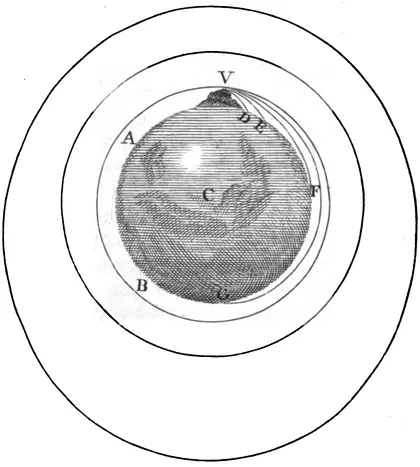
Newton’s own figure. Shots fired from the mountaintop V land at D, E, F and G, each farther around the Earth; faster still, they circle it.
Isaac Newton, A Treatise of the System of the World (London, 1728). Public domain. · Wikimedia Commons
Near the ball never lands: it is in orbit. A little faster and the path stretches into an ellipse that swings out and comes back. At about , the escape speed, the ball leaves for good.
Gravitation
Gravity does not point “down” in some fixed direction. It points toward Earth’s center, so as the ball travels around the planet, “down” swings around with it. It also weakens with distance, following Newton’s law of gravitation:
GM.Newton’s gravitational constant times Earth’s mass, about . Only the product matters for motion around Earth.
r.Distance from Earth’s center, not height above the ground.
R.Earth’s radius, about . At , the formula gives the familiar surface value .
The weakening with height is gentler than people often expect. The International Space Station orbits about up, where gravity is still close to of its surface value. Astronauts float because they and the station are falling together, the way Newton’s cannonball falls around the Earth, not because gravity has switched off.
In the solar system, Kepler’s first law says planets move on ellipses with the Sun at one focus. The cannonball is a special case of this law. Every path is a piece of a conic section (an ellipse, or a hyperbola for escape) with Earth’s center at a focus.
This also includes the slow shots. When the ball hits the ground, the ground is simply interrupting an elliptical trajectory. If all of Earth’s mass were squeezed into a point at the center, the ball would keep going, dive around the center and come back up to the cannon. In these short-range cases, the segment of an ellipse is indistinguishable from a parabola. The idealized parabola from projectile motion can be thought of as an approximation to a very narrow ellipse, valid when the trajectory is small compared to Earth’s radius.
Why do the parabola and the ellipse agree near the top?
Why do the parabola and the ellipse agree near the top?
At the top of any path, the velocity is horizontal and gravity points straight down, perpendicular to it. All of the acceleration goes into bending the path, like the centripetal acceleration of circular motion. The path’s radius of curvature at that point satisfies
This is true for the textbook parabola (constant ) and for the real path (the at the cannon’s height). The two curves leave the cannon in the same direction and bend at the same rate, so they agree for as long as keeps the same size and direction.
They separate once the ball has traveled a noticeable fraction of . The real acceleration tilts toward the center by an angle of about , and the flat ground of the textbook model sits above the real, curving ground by about . For a baseball throw, .
The ball never lands when its path bends exactly as much as the Earth’s surface, :
That is a circular orbit, the special case of an ellipse where both foci meet at the center.
Problem Solving
Orbiting Just Above the Ground
Orbiting Just Above the Ground
Problem
Ignoring air, how fast must a ball skim horizontally over the surface to orbit Earth, and how long does one lap take? Use and .
Use
Solve
Check
The ISS, a few hundred kilometers higher, laps Earth in about minutes, a little slower as expected for a larger orbit.
Gravity on the Space Station
Gravity on the Space Station
Problem
The ISS orbits about above Earth’s surface. What fraction of surface gravity acts on it?
Use
Solve
Check
is only about of Earth’s radius, so gravity barely drops. The crew is weightless because they are in free fall, not because gravity is small.
Cannonball Checkpoint1 of 3